Nautilus Art Car Not at Burning Man This Year
Today the element of group i desert is quiet. The roar of techno music and flamethrowers has been replaced with the soft clink of rakes and trash cans. Thousands of people put aside their hangovers to methodically clean the desert. Afterward a dedicated communal cleaning, Called-for Man, one of the largest arts events in the world, spanning 7 days and involving over 70,000 participants, leaves not a single wrapper on the desert. Amongst the swarm of salt-crusted denizens of this imperceptible city (known as Burners) is us: a scientist who studies cooperation, an industrial designer, and a Silicon Valley security CEO. Among the dismantled rigs, lifeless pyrotechnics, and bowed heads of Burners absorbed in cleaning, we are here trying to answer a simple question: How, afterwards so many years, could Burning Man throw an effect of such chaos, and yet leave the desert without a trace? What leads thousands of people in such an farthermost environment to consistently engage in cooperative behavior at a scale seldom seen in society?
To answer that question, nosotros must commencement our journey at the MIT Media Lab, in an aptly named research grouping: Scalable Cooperation. This group studies how technologies—social media, the Internet, artificial intelligence—can empower cooperative homo networks. The group's heritage includes the scientists who solved DARPA'due south Scarlet Airship Challenge in 2008, in which the United states government scattered ten ruddy weather balloons beyond the continental U.S., and instructed teams of researchers to locate them every bit fast equally possible. The winning MIT team found all 10 balloons in just under nine hours using the virality of social media and an incentive structure that motivated people to recruit their friends. This result was a resounding success for crowdsourcing and the Internet at large, demonstrating that a collective of individuals, continued through technology, could together solve large-scale problems that no individual could solve alone.
Our experiment was a play on the famous Small Globe Experiment, which led to the phrase, "six degrees of separation."
This aforementioned squad, withal, struggled with other Cyberspace-based forms for mass cooperation. During the 2011 DARPA Shredder Challenge, which involved recruiting and coordinating individuals on the Internet to collectively recombine shredded documents, people took advantage of the trust necessary for large-calibration collaboration. Adversarial participants from the other teams, who felt the crowdsourcing essentially amounted to "adulterous," posed every bit volunteers and sabotaged the crowdsourcing effort,1 rendering cooperation impossible. Fast-forward five years, to the 2016 presidential election, and we run into how this antagonism tin can be a serious problem for genuine commonage action. Bad actors proliferated misinformation at such a rate that The New York Times declared, "The Net trolls take won. Sorry, there'south not much yous can do."
And then when practise networks enable cooperation to thrive? And when do they hinder it? A vast body of work from across anthropology, psychology, and sociology has explored the conditions under which cooperation—the propensity for individuals to pay a personal price for the do good of the whole—operates. Michael Tomasello'due south book Why We Cooperate recounts numerous experiments with children and apes to argue that cooperation is an innate trait that has evolved on an evolutionary timescale. While he acknowledges that genetics impacts cooperation, he also stresses that the environments in which we grow upward fundamentally shape our ability to cooperate. Nature and nurture. A defining characteristic of our species is that nosotros often operate within complex social institutions that both require and facilitate cooperative behavior.
Over the years, scientists have examined how these social networks tin can be configured to maximize cooperation. In a 2011 study, David Rand, Samuel Arbesman, and Nicholas Christakis show that many types of social networks cause cooperation to devolve.2 In particular, they prove that networks where people cannot update their connections based on interactions, or when these updates are random, cooperation decays over time. But they also demonstrate that in networks where individuals can hands change who they interact with, cooperation is stable. This suggests that how we design our social networks—our communities and our institutions—plays a disquisitional role in determining the prevalence of cooperation.
Merely can we see the aforementioned effects on cooperation on the networks of society exterior of the laboratory? Perhaps the nearly influential report that explores this question is Stanley Milgram's Modest World Experiment, which sent hundreds of envelopes on journeys across the United states of america. Milgram was fascinated by the paths that information takes through a community and what they can tell u.s.a. well-nigh the construction of social networks.3 Milgram sent letters to random individuals in the U.S.—each containing information about a final target person, and instructions to pass the letter along to the friend who would become it closer to the target. Through this, he measured the path length between individuals and demonstrated that we live in a "modest globe," where a surprisingly small number of friends connect whatsoever 2 people (commonly known equally vi degrees of separation). But at that place was i significant flaw in Milgram's and similar experiments: Only xix percent of the letters yielded successful chains. In digital replications of his experiment, that number dropped to as depression every bit one.5 per centum. In all these experiments, getting people to participate was hard. Because people are busy and engaged in their usual environments, they had little incentive to help out.
Now let's render to our team in the desert. To explore how and when cooperation tin can thrive in gild, we decided to examine a dissimilar, extreme environment known for its ability to foster cooperation at a large scale: Burning Man. A community event that takes identify one time a year in the Black Rock Desert of Nevada, Burning Man has been characterized by some as little more than than a hedonistic playground for dusty hippies and Silicon Valley's elite. Indeed, Called-for Homo embodies anarchy. But embedded in its chaos exists a sophisticated machinery for customs organization, local governance, and participatory action. A central part of this organization is the Called-for Man 10 Principles, which serve equally the ideological design for the entire issue. The 10 Principles contain ideas such as gifting—which encourages people to share with others without any explicit bounty and participation—which invites any person to contribute to collective action. Nosotros hypothesized that these principles create an surround where cooperation emerges in ways unseen in the globe of Milgram and laboratory studies.
Serendipity struck once again in Rhode Island. "Expect, I call up I'm part of this project!" a woman told the states.
Our experiment, incubated in Scalable Cooperation in collaboration with computer and network scientists, was a play on the Small Earth Experiment. We designed it with the aforementioned structure of Milgram's original 1962 study, routing information through Burning Man's social network with a series of parcels. These parcels, which we named "Vessels" (considering everything at Burning Man can and should have a vaguely ritualistic name), were handed out on the first day of Burning Homo 2018, containing information about a particular individual at Burning Homo. The clearly stated goal of the vessel was to cease upward in the possession of this individual, so we refer to them as the Terminus. From mitt-off to hand-off, these Vessels would collect a variety of data, stories, and data nigh their journey. We hoped these journeys would permit us to quantitatively map the connectivity of the Burning Man community and qualitatively empathise how people engage with Called-for Man culture. We hoped non only to count the number of hops of each successful chain, and compare that measure of social connectivity with Milgram'southward six degrees of separation, but also to see what cultural, geographic, or attitudinal factors affect success rates. These are not questions that can be probed by scientific methods lone, so we enlisted the input of designers and artists in gild to improve explore the subjectivity of Burning Human being'southward magic.
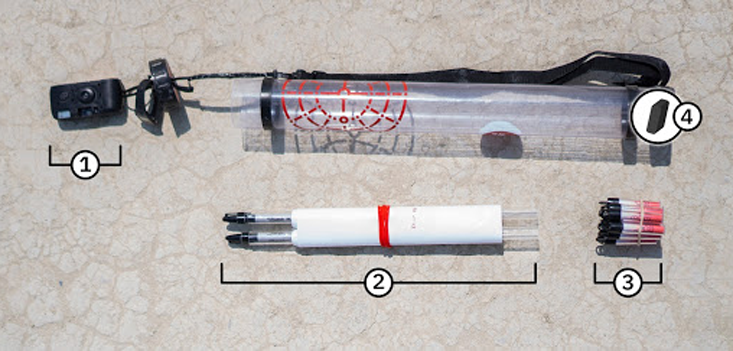
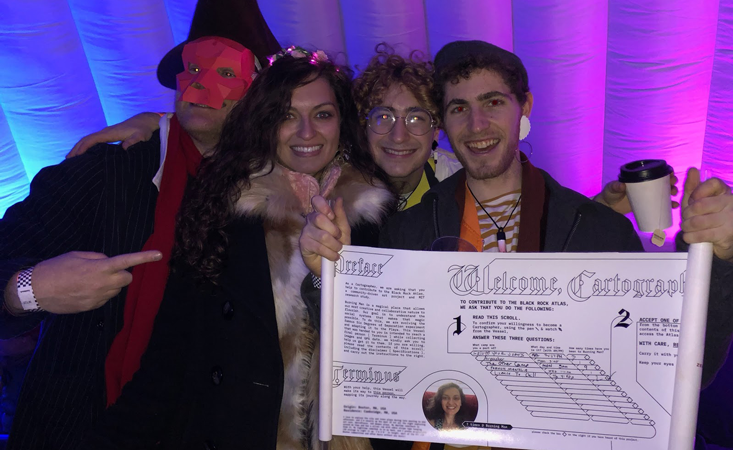
But what should the Vessels look similar? Nosotros spent the summer leading up to the event talking to Burners in order to find out. We gleaned as much information as we could almost the aspects of Called-for Human that enable cooperation and creativity. For example, we learned that art at Burning Human is not passively observed like in a museum, but rather invites agile interaction such as climbing, touching, or drawing. Oftentimes, this relationship is generative, taking on new interactions beyond the original intent of the creative person. To capitalize on this, the terminal contents of each Vessel contained a disposable camera, a scroll, gift pendants, and a GPS tracker. These objects created a ritual of souvenir commutation and creative user participation, while providing incentives to keep the Vessels moving. The camera allowed each participant to contribute their experience to the projection, while generating a visual tape of each Vessel's journeying. The pendants contained a web URL that allowed participants to access the project in its final form and provide valuable feedback on their experience. The GPS unit of measurement allowed us to see how the Vessels traveled across the desert, and to build a data-driven map of mobility.
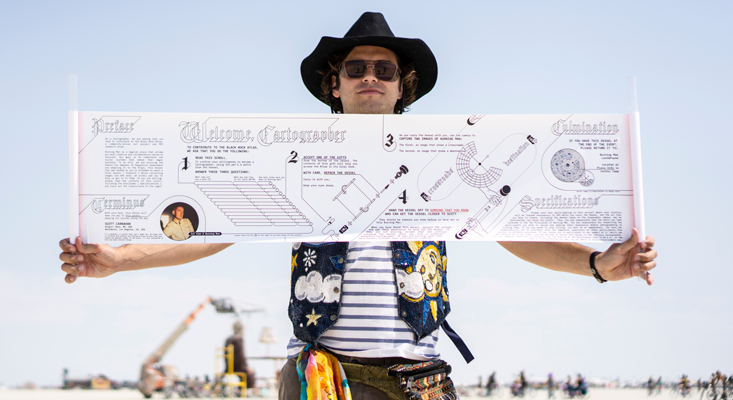
The Vessel also contained a scroll resembling a Hebrew Torah with instructions for the experiment, the information for finding the Terminus, and the necessary context and disclosure. Based on our enquiry into the Burning Human Glossary, we advisedly mediated the writing style of the text, crafting a vernacular of ritual and removing words that were inaccessible or that seemed overly "default"—Burning Man's term for the exterior globe.
In gild to select individuals as the destination for each Vessel, nosotros collaborated with the Called-for Man Journal on a broadcast that asked the Called-for Man community to sign upwards for participation. We expected only a handful of people to be willing to help with the project. To our surprise, we were flooded with volunteers and offers of back up, from people all over the world. From a unmarried blog postal service, over 350 people offered to become a Terminus, giving us a diverse and representative subject pool. In their correspondence to us, Burners said things like: "Super excited for your project! I did my Ph.D. on network community structure. Would exist thrilled to help assemble information and analyze." and "I'chiliad excited to be involved with this project! Let'due south go far happen!"
From that pool of 361 volunteers, we carefully choose our 15 final Terminii to mirror the demographic distributions of the larger Burning Man population on features such as age, origin, experience, and gender. Based on these criteria, we randomly selected 15 people in gild to not introduce experimenter bias into the methods (for our total method, please run into our research paper).4
For each Terminus, their respective scroll included their name (birth name and "Playa" name), their flick, their city of origin and their home city, and a cursory sentence that described their interests. With the details provided, we were careful to share enough data and then that the Vessel could be routed to someone closer, but not too much information (say, the Terminii'due south camp location) that would make social search trivial. One Terminus was a blue-bearded Burning Human Ranger with a flamethrower who drove effectually on a Cookie Monster art automobile. Another was an entomologist who wore wings and antennae. A third was a performer in his 70s who danced to EDM through the night.
On Aug. 27, 2018, we trekked into the desert in search of cooperation. Called-for Man is known for the astringent traffic involved with routing tens of thousands of vehicles on a unmarried dirt route. In some cases, it tin accept eight hours to travel half a mile. Simply instead of the headache of urban traffic jams, nosotros were greeted with something more than akin to a decentralized party. Effectually us, people shared snacks and sunbathed on roofs—it was generally a good time.
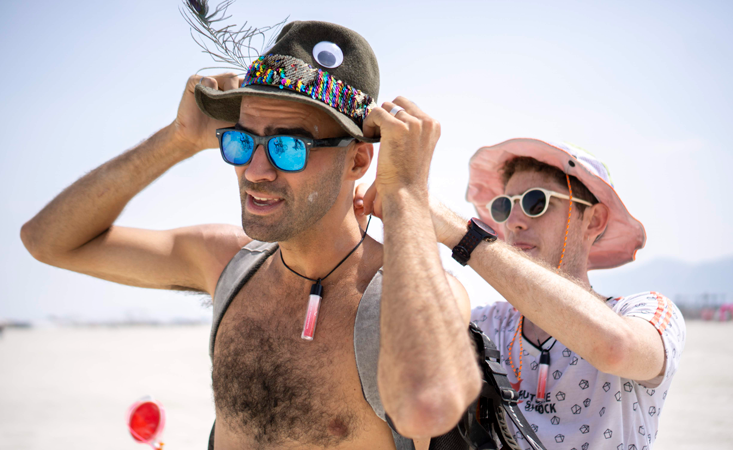
The adjacent forenoon, we activated the 15 GPS units, epoxied them into the Vessels, and went to Inner Playa—the central hub of Black Stone Urban center—to launch our experiment. Forth the way, we passed out pendants to the many curious passersby. We hoped the pendants would help to create a visible community of people associated with the project, building hype and visual presence on the Playa.
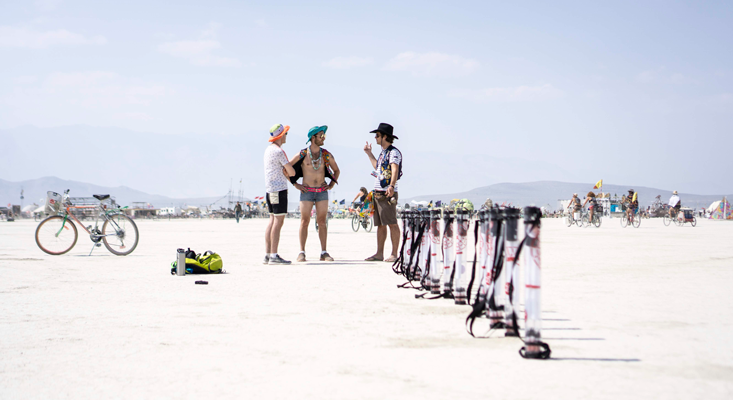
We bundled the Vessels to ship in a line. In truthful Called-for Homo mode, we loudly made our presence known by heckling passersby. To the folks we assembled, we explained the nature of the experiment and asked them if they would like to contribute. Those who accepted the challenge became the start Cartographers. Over the grade of one hour, we handed out all xv Vessels and returned to camp to celebrate with a basin of dusty chili.
The scrolls stipulated that the Vessels should exist returned to the Called-for Human being Lost and Plant if the Vessel establish its style to the Terminus, or if the upshot concluded. After the dust and ash had settled at the end of the Burn, three Vessels establish their way back to the Lost and Found and we grabbed them on our manner out. We were exhausted from the long week, merely excited to analyze the results.
Due westdue east returned to the MIT Media Lab, and a few days afterwards, strange packages started to make it. Information technology turns out two more Vessels had been turned into the Called-for Man Lost and Plant subsequently nosotros had left the Black Rock Desert. These Vessels had been kindly mailed dorsum to us by the Lost and Found staff. After inspecting the five total Vessels, it seemed like our endeavor at social search was unsuccessful. We reached out to all xv Terminii to encounter if they had received their Vessel, and discovered that none of the Vessels successfully made its mode to its Terminus.
We learned, all the same, that some of the Vessels got very close. I Terminus, a Blackness Rock Ranger, said that his Vessel found its mode to the Ranger headquarters, and that he received a bulletin to pick it upwards. When he went to retrieve it, however, the Rangers could non detect the Vessel. It was eventually found, only not until the he had already left Black Rock City. Another Terminus said that one of his campmates, by the proper noun of Mango, returned to military camp with a Vessel for a dissimilar Terminus. Mango had been tasked to observe someone else, driving a truck repurposed to look like a giant snail. Despite these close calls, it looked similar cooperation had failed at Burning Man. The anarchic network of Burning Man was simply that: anarchic. If at that place was a manner to efficiently road information through the community, nosotros didn't observe it.
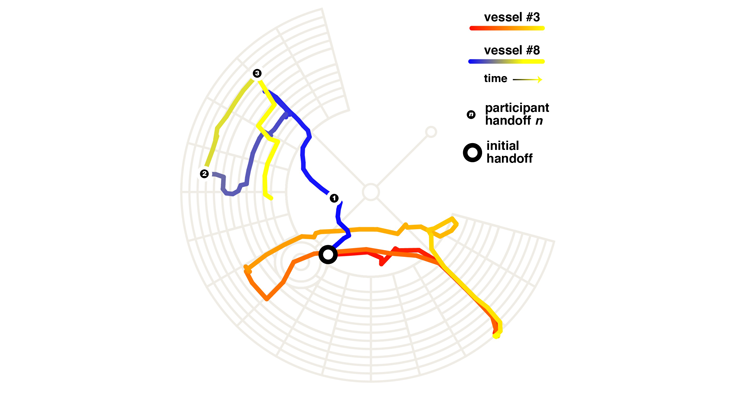
But information technology all changed 1 fateful day in Oct. "You won't believe this," an email from Terminus #11, a performer whose existent name is Steve, read, "but I finally received the Vessel at Denver'due south Decompression last Saturday night! Everything looks to be intact, including the scroll, camera, and GPS unit at the bottom. How can I go virtually getting it back to yous to be included in the Atlas?"
The Decompression event he was referring to is a key part of integrating back into regular life after Burning Man, by convening local burner communities all over the world to "gloat and cope with re-entry." The person who had the vessel (and asked to remain anonymous) at the end of Burning Human was too from Denver, and figured while they couldn't become it to Steve on Playa, they could bring it home and effort to discover him in Colorado. According to Steve, they reached out to him on Facebook and met up at the Decompression event for the exchange. The roll explicitly said that the concluding person with the Vessel should render it to Lost and Found. Simply the penultimate person in Steve'southward successful chain decided to ignore the rules and take the Vessel back to Denver with him, determined to observe the Terminus. In the end, not just did the Vessel make its way to its Terminus in four hops, but information technology also crossed state borders to practise so. Past the time Steve's Vessel made it back to us in Cambridge, Massachusetts, all the pendants were gone, only in return it was packed total of Burning Man gifts: stickers, headbands, and dust.
Nosotros saw a network that champions cooperative endeavor and whimsical inventiveness over efficiency.
Serendipity struck once over again when we made our way to the Decompression issue in Providence, Rhode Island. We had casually brought with us a couple of the unclaimed Vessels from Lost and Found to the Decompression, just to evidence people what we had been working on. Lo and behold, nosotros were chatting a friendly woman, explaining the projection, when her demeanor apace changed. "Wait, I think I'm part of this project!" Nosotros ourselves had found Terminus #12! And even more than incredibly, one of the Vessels we had brought was destined for her. We presented Terminus #12 with her Vessel, and inadvertently become the penultimate links in the six-person chain that got the vessel to its terminus. We, the researchers, had accidentally found Terminus #12, not in the desert, but on the other side of the country, on a common cold Providence nighttime.
When we started on this journeying, we expected to cleanly measure the efficiency of a social network, just as Milgram had washed over fifty years ago. We idea charting the Vessels' routes would be as straightforward every bit collecting the Vessels and calculating the charge per unit of render based on the chain lengths. But that'due south non what nosotros discovered at Burning Human. We learned something more valuable.
In our commercial club, networks are designed for efficiency and growth. They are configured for optimal routing. Exist in that location on time, don't wander, profits depend on information technology. The aforementioned is true for what has become of the Internet. Optimists envisioned it as a decentralized network of individuals that could upend the hierarchies of government and corporations. But today dominant sites, built on proprietary algorithms and overrun by advertising, have commodified personal identity and reinforced political echo chambers.
At Burning Homo, we got a powerful glimpse of a social network that breaks the bondage of techno-hierarchy. We saw a network that champions cooperative effort and whimsical inventiveness over efficiency. These values create a unique context where unexpected optimism and serendipity are the norm. Our experiment showed us what people tin can be when freed from confining networks, and that vision burns vivid. We can design social networks—our communities, our institutions, and our communication platforms—to embody the cooperative and optimistic spirit that affirms our humanity. Cooperation doesn't accept to be forced on us, information technology can come up from within us. That'due south how a desert is cleaned. And how a Vessel finds its mode home.
Ziv Epstein is a Ph.D. student at the MIT Media Lab. Micah Epstein is a designer, systems thinker, and recent graduate of the Rhode Island School Of Design. Christian Almenar is cofounder and CEO of the Silicon Valley-based CyberSecurity company Intrinsic. Manuel Cebrian is a inquiry scientist at the MIT Media Lab and the Eye for Humans & Machines at the Max Planck Institute for Human Development.
We would like to thank our collaborators on the project, Matt Groh, Niccolo Pescetelli, Nick Obradovich, Esteban Moro, and Iyad Rahwan, for helping to bring science to the Playa. In particular, Nick and Esteban made crucial contributions to the research design and experimental methods, and Iyad brought the team together and provided intellectual, strategic, and logistical back up. We would like to thank Stuart Mangrum and Caveat Magister at the Burning Man Organization for providing institutional resources, and Lauren Carly at the Burning Man Lost and Found. A big cheers to Sway and the residuum of the Scutoid family unit for their kindness and hospitality during the Burn. We would also like to thank bunnie Haung, Sarah Newman, Kim Albrect, Daniel Yudkin, Oren Lederman, Dan Novy, and Jie Qi for invaluable give-and-take, ideas, and feedback. Nosotros would also like to give thanks Pecker Powers, Matthew Eva, Mary Cait Milliff, and Blakeley Hoffman Payne for insightful edits on this commodity. Finally, nosotros would like to thank the 15 Terminii who participated in the projection, and the Burning Homo customs at large for their back up and enthusiasm.
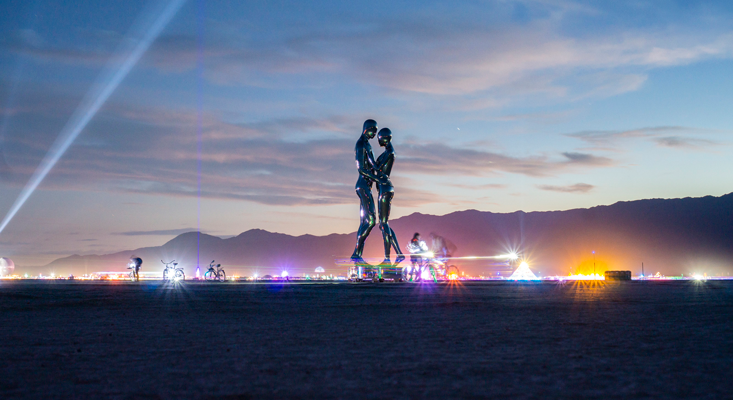
Pb photograph by Micah Epstein.
References
1. Press release. UC San Diego team's effort in DARPA's shredder challenge derailed by demolition. JacobsSchool.ucsd.edu.
2. Rand, D.G., Arbesman, S., & Christakis, North.A. Dynamic social networks promote cooperation in experiments with humans. Proceedings of the National Academy of Sciences 108, 19193-19198 (2011).
iii. Milgram, South. The small world probem. Psychology Today 2, 60-67 (1967).
four. Epstein, Z., et al. Towards a new social laboratory: An experimental written report of search through community participation at Burning Human. arXiv.org abs/1903.04125 (2019).

Go the Nautilus newsletter
The newest and most pop articles delivered right to your inbox!
Source: https://nautil.us/six-degrees-of-separation-at-burning-man-8311/
0 Response to "Nautilus Art Car Not at Burning Man This Year"
Post a Comment